

Medical Device Connectivity Market to reach USD 28.80 Billion by 2035 at 21.1% CAGR
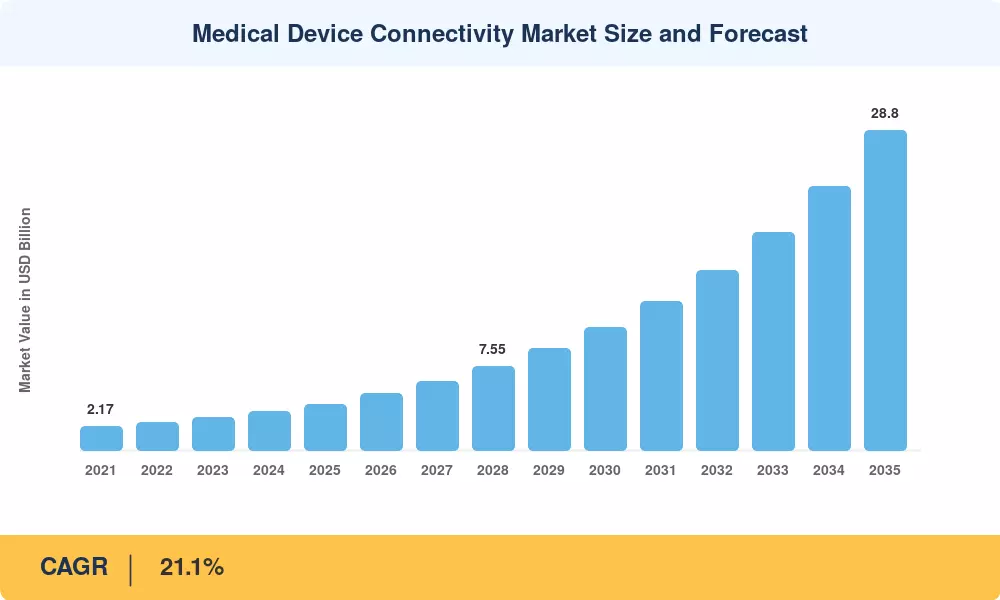
Medical Device Connectivity Market Size
Medical Device Connectivity Market to Surge from USD 5.15 Billion in 2026 to USD 28.80B by 2035-By Information-Blocking Regulation, Clinician Workforce Shortage
NY, CA, UNITED STATES, July 21, 2026 /EINPresswire.com/ -- As per Market Research Future, the global Medical Device Connectivity Market size to reach USD 28.80 Billion by 2035 from USD 5.15 Billion in 2026, at a CAGR of 21.1% during the forecast period 2026--2035. The market base was estimated at USD 4.18 Billion in 2025.The 21.1% CAGR---anchored by regulatory compliance mandates rather than discretionary IT spending---is driven by three converging forces: the US 21st Century Cures Act's information-blocking provisions and the European Health Data Space regulation that penalize proprietary data silos and incentivize open-standard connectivity, a global clinician workforce shortage projected at 10 million healthcare workers by 2030 that makes automated data capture an operational imperative rather than an elective upgrade, and the expansion of value-based reimbursement models that tie CMS bundled-payment programs directly to patient outcomes and readmission rates, requiring continuous device-to-EHR data flow for real-time deterioration scoring.
Request A Free Sample: https://www.marketresearchfuture.com/sample_request/6041
Key Market Trends & Growth Drivers
Information-Blocking Regulation and Open-Standard Connectivity Mandates
National and multilateral regulators increasingly require device-generated data to flow through certified, standards-based connectivity interfaces rather than proprietary gateways. The ONC's HTI-1 final rule, effective January 2024, expanded the definition of information blocking to include device-generated data, compelling hospital networks to replace proprietary gateways with certified, standards-based connectivity.
Penalties of up to USD 1 million per violation have transformed connectivity from a discretionary IT upgrade into a compliance mandate. The European Health Data Space regulation requires cross-border portability of clinical data by 2027, directly increasing demand for interoperable device interfaces across the continent's 15,000-plus acute-care facilities. Each new regulatory enforcement action translates into measurable procurement volume for device interface modules and integration engines, and the structural durability of these mandates makes this driver persistent through 2035.
Clinician Workforce Shortage and Automated Data Capture Imperative
The WHO projects a global shortfall of 10 million healthcare workers by 2030, with nursing vacancy rates already exceeding 18% in US hospitals. Automated device connectivity eliminates an estimated 30 minutes of manual documentation per nurse per shift, translating into measurable labor-cost savings.
Health systems such as Kaiser Permanente have reported 22% reductions in transcription errors after deploying enterprise-wide device integration platforms, reinforcing the ROI case for connectivity investment across the Medical Device Connectivity Market. In high-acuity settings where clinical staff are exposed to more than 350 alarms per bed per day, connected-device data streams paired with machine-learning models can suppress non-actionable alerts by up to 85% while surfacing genuine clinical deterioration events.
Value-Based Reimbursement Expansion and Quality-Linked Connectivity
CMS's bundled-payment programs now cover more than 40% of Medicare discharges, tying reimbursement directly to patient outcomes and readmission rates. Continuous device-to-EHR data flow enables real-time deterioration scoring, which clinical evidence links to 15--20% reductions in ICU readmissions.
Private payers are following suit: Aetna and UnitedHealth Group introduced connectivity-dependent quality bonuses in 2024, extending the financial incentive to deploy connected-device infrastructure beyond the Medicare population. The 2024 CMS expansion of Remote Patient Monitoring billing codes now covers 175+ device categories, from blood-pressure cuffs to continuous glucose monitors, enabling providers to bill for device-sourced data interpretation at home and creating a structural reimbursement tailwind for the Medical Device Connectivity Market.
5G and Next-Generation Wireless Infrastructure Rollout
Private 5G networks are moving from pilot to production in hospital campuses, offering sub-10-millisecond latency that supports real-time waveform streaming from ventilators, infusion pumps, and physiological monitors. The US FCC allocated an additional 100 MHz of mid-band spectrum for healthcare in late 2024, while Japan's NTT Docomo partnered with three national university hospitals to trial 6G connectivity for robotic-surgery teleoperation.
Wi-Fi 6E introduced the 6 GHz band, virtually eliminating congestion in dense hospital environments, while Bluetooth Low Energy 5.3 supports mesh networks of patient-worn sensors across entire ward floors. These infrastructure investments create a secular tailwind for wireless device connectivity across the Medical Device Connectivity Market.
Ask for Customization: https://www.marketresearchfuture.com/ask_for_customize/6041
Market Segment Insights
BY COMPONENT
Connectivity Solutions: Dominant segment with ~67.3% revenue share in 2025. Reflecting strong demand for device interface modules, integration engines, and gateway hardware that translate proprietary serial or USB protocols into standardized digital outputs. Device interface modules represent the highest-volume hardware category, benefiting from a captive replacement cycle as hospitals refresh bedside equipment on 7--10 year intervals. Medtronic's Vital Sync patient management and GE HealthCare's Mural virtual care anchor this segment.
Connectivity Services: Fastest-growing component segment at 23.2% CAGR (2026--2035). Implementation and integration engagements spanning multi-year deployment timelines drive recurring revenue. A typical 500-bed hospital integration project runs 12--18 months and requires clinical workflow consulting, HL7/FHIR mapping, and go-live support. Managed-services contracts---where vendors assume ongoing maintenance and monitoring---are gaining share within this segment, reflecting hospitals' preference for operational simplicity.
BY TECHNOLOGY
Wired Connectivity: Dominant technology with 61.4% share in 2025. Ethernet-based connections offer deterministic latency and immunity to RF interference, remaining critical for real-time waveform streaming from ventilators and anesthesia machines in ICUs, operating rooms, and catheterization labs. Wired connectivity dominates in high-acuity environments where uninterrupted data flow is clinically non-negotiable.
Wireless Connectivity: Fastest-growing technology segment at 22.9% CAGR (2026--2035). Wi-Fi 6E introduced the 6 GHz band, virtually eliminating congestion in dense hospital environments, while Bluetooth Low Energy 5.3 supports mesh networks of patient-worn sensors across entire ward floors. New hospital construction increasingly specifies wireless-first connectivity architectures that reduce cabling costs by 25--35%. Private 5G campus networks are already operational in leading US academic medical centers, and early 6G research programs in Japan and South Korea target sub-millisecond latency for haptic-feedback surgical robotics by 2033.
BY APPLICATION
Continuous Patient Monitoring: Dominant application with 49.2% share in 2025, representing roughly USD 2.06 Billion. Fueled by sepsis-alert and early-warning-score algorithms that require uninterrupted device data streams. High-acuity monitoring generates 200+ data points per patient per hour, and automated EHR capture is the only scalable way to manage this volume without increasing nursing FTEs. This application touches every connected bed in acute and step-down units.
Tele-ICU and Tele-Stroke: Fastest-growing application segment at 24.2% CAGR. Reflecting specialist-shortage pressures across rural and mid-size hospitals, powered by hub-and-spoke models where a central intensivist team monitors 150--200 remote ICU beds simultaneously. The American Telemedicine Association estimates that tele-ICU programs reduce mortality by 15--20% in covered units, creating strong clinical and financial justification for hospitals to invest in the underlying connectivity infrastructure.
Asset Management: USD 0.31 Billion in 2025, driven by RTLS-enabled equipment tracking that reduces device loss and improves utilization rates across hospital campuses.
Clinical Documentation: Growing at 18.5% CAGR (2026--2035), as auto-charting from device data eliminates manual transcription and reduces documentation errors by an estimated 22%.
BY END USER
Hospitals and Clinics: Dominant end-user segment with 71.4% share in 2025. A 500-bed academic medical center typically deploys 3,000--5,000 networkable devices across its campus. Regulatory mandates around quality reporting and information blocking make connectivity a compliance prerequisite rather than an elective upgrade. CMS quality-reporting requirements now include device-sourced vital-sign data for sepsis bundles, directly tying connectivity to reimbursement eligibility.
Home Healthcare: Fastest-growing end-user segment at 24.8% CAGR. As chronic-disease management shifts to decentralized settings, patients with conditions like COPD, heart failure, and diabetes require continuous remote monitoring that feeds directly into provider EHR systems. CMS's 2024 expansion of RPM billing codes now covers 175+ device categories, enabling providers to bill for device-sourced data interpretation at home. This structural reimbursement shift will sustain above-market growth rates in the home segment through 2035.
Ambulatory Surgical Centers: USD 0.18 Billion in 2025, serving outpatient volume migration with connectivity for perioperative monitoring and automated documentation.
Diagnostic Laboratories: Growing at 17.2% CAGR (2026--2035), driven by LIS-to-EHR data exchange requirements and automated result reporting from connected diagnostic devices.
Regional Outlook
North America -- Dominant Market (~40.7% Share, 2025)
The United States generates approximately 78.5% of North American Medical Device Connectivity Market revenue, driven by ONC information-blocking enforcement, near-universal EHR adoption rates around 95% across US hospitals, and CMS quality-reporting requirements that include device-sourced vital-sign data for sepsis bundles. With more than 6,100 acute-care hospitals and mature EHR adoption creating a ready substrate for device integration, the US remains the anchor of the regional market.
Canada contributes through Ontario Health digital transformation at 14.2% CAGR, while Mexico is growing on IMSS hospital modernization program at USD 0.05 Billion in 2025. North America's leadership rests on reimbursement depth and the structural compliance mandates created by expanded information-blocking enforcement and cybersecurity regulatory mandates.
Europe -- Fastest-Growing Region (23.8% CAGR, 2026--2035)
Europe's Medical Device Connectivity Market reflects regulatory convergence: the EHDS mandates device-data portability, France's Ségur du Numérique allocated EUR 2 billion to hospital digital upgrades, and Germany's ISiK specification requires all hospitals to expose standardized FHIR endpoints by 2026. Germany leads regionally with 26.3% of regional share on the ISiK interoperability mandate.
The UK is growing at 22.7% CAGR on the NHS Federated Data Platform pilot that aggregates device data from 42 integrated care systems. France contributes USD 0.14 Billion through Ségur du Numérique funding. Italy is growing at 18.9% CAGR on PNRR digital-health investment. Spain contributes USD 0.07 Billion on autonomous-community telemedicine rollouts. The Nordic countries are growing at 24.1% CAGR on the Nordic eHealth cooperation framework. Harmonization pressure from ECDC guidance and the EU4Health program is gradually narrowing national differences, lifting baseline demand across the region.
Asia-Pacific -- Second Largest (USD 0.85 Billion, 2025)
Asia-Pacific is the engine of volume growth in the Medical Device Connectivity Market. China holds the largest regional share at 35.8%, with the National Health Commission requiring all Grade III hospitals---numbering more than 3,000---to achieve smart-hospital certification by 2027, a mandate that includes end-to-end device connectivity as a core evaluation criterion. India is growing at 27.4% CAGR on the back of Ayushman Bharat Digital Mission expansion, with Health IDs exceeding 500 million registrations and creating the identity layer needed for device-to-cloud data linkage.
Japan contributes USD 0.12 Billion through the Society 5.0 healthcare strategy at 4.8% CAGR. South Korea is growing at 22.5% CAGR on the K-Health digital infrastructure program. ASEAN economies show solid growth at 20.1% CAGR as public-hospital IT modernization accelerates. The region's combined contribution anchors the global volume base for connectivity demand.
South America -- Growing Presence (USD 0.78 Billion, 2025)
Brazil anchors South America's Medical Device Connectivity Market at ~58.2% of regional revenue, with the Unified Health System (SUS) serving 150 million citizens across 6,700 public hospitals. The Ministry of Health's digital transformation roadmap mandates bedside-device integration in all federal tertiary facilities by 2028.
Argentina contributes through telehealth regulation expansion at 21.3% CAGR. The rest of South America is growing steadily on IDB-funded hospital digitization. Vendor-neutral connectivity platforms that support Portuguese-language clinical interfaces are gaining traction across the broader region.
Middle East & Africa -- Emerging Opportunity (USD 0.20 Billion, 2025)
The Middle East & Africa carries the widest connectivity gap and therefore the steepest opportunity. Saudi Arabia leads the region with 32.5% of regional share through Vision 2030 health infrastructure, including 35 new hospital construction projects with connectivity-by-design specifications. The UAE is growing at 28.6% CAGR on smart-city hospital projects, with the DHA mandating real-time device-data reporting across all Dubai Health Authority facilities. South Africa is growing on NHI implementation roadmap at USD 0.03 Billion.
Egypt is growing at 22.8% CAGR through universal health insurance rollout. These greenfield deployments allow emerging-market hospitals to bypass legacy infrastructure constraints that slow adoption in mature markets. Cold-chain and legacy device gaps remain a restraint---an estimated 60--70% of the world's bedside monitors, ventilators, and infusion pumps in active clinical use predate IEEE 11073 and HL7 FHIR standards.
Competitive Landscape and Recent Developments
The Medical Device Connectivity Market is moderately concentrated, with the top five manufacturers accounting for an estimated 35--42% of total revenue share. The competitive landscape includes large-cap medical device OEMs with embedded connectivity stacks, enterprise IT conglomerates with horizontal integration platforms, and pure-play connectivity experts. M&A increased during 2023--2025 as EHR vendors and device manufacturers sought vertical integration methods. Concentration is highest in high-income segments where regulatory and cybersecurity barriers are steep; the pooled-procurement tier is more fragmented as regional producers compete on price.
The competitive landscape is stratified between premium connectivity leaders serving adult and private markets, high-volume low-cost suppliers capturing government-aligned tenders, and platform-ecosystem specialists consolidating the hospital IT stack.
KEY COMPANIES AND RECENT MILESTONES
Medtronic plc (2024--2025): Maintains leadership with Vital Sync patient management and device integration middleware, commanding ~8--11% of global Medical Device Connectivity Market revenue. Vertically integrated OEM with more than 500 connected device models, with premium positioning in critical-care monitoring ecosystems offsetting tender-price compression in pooled procurement.
GE HealthCare Technologies (2024--2025): Mural virtual care and CARESCAPE connectivity anchor a strong North America franchise, holding ~7--10% of global revenue. The company benefits from strength in critical-care monitoring ecosystems and the structural compliance mandates created by expanded information-blocking enforcement.
Future Outlook: 2026--2035
By 2030, digital immunization registries and enterprise-wide device connectivity architectures will become the operating system of healthcare delivery. WHO targets near-universal digital registry adoption across member states by the early 2030s, enabling defaulter tracking that lifts care continuity---the metric most correlated with Medical Device Connectivity Market growth.
Electronic health records generate granular device data that manufacturers and ministries can monetize through demand-forecasting and population-health analytics services, creating a new business model layered on top of the core connectivity franchise.
More Related Research Insights:
https://www.marketresearchfuture.com/reports/pericarditis-drug-market-43366
https://www.marketresearchfuture.com/reports/peripheral-vascular-devices-accessorie-market-43754
https://www.marketresearchfuture.com/reports/personal-lubricant-market-43679
https://www.marketresearchfuture.com/reports/pharmaceutical-contract-manufacturing-research-service-market-43665
https://www.marketresearchfuture.com/reports/pharmaceutical-hot-melt-extrusion-market-43233
https://www.marketresearchfuture.com/reports/pharmaceutical-industry-market-43636
https://www.marketresearchfuture.com/reports/pharyngeal-cancer-therapeutics-market-27674
https://www.marketresearchfuture.com/reports/phosphor-plate-scanner-market-43253
https://www.marketresearchfuture.com/reports/photoacoustic-imaging-market-22154
https://www.marketresearchfuture.com/reports/picks-disease-treatment-market-39454
Larry Wilson
WantStats Research And Media Pvt. Ltd.
+1 855-661-4441
email us here
Visit us on social media:
LinkedIn
Facebook
YouTube
X
Legal Disclaimer:
EIN Presswire provides this news content "as is" without warranty of any kind. We do not accept any responsibility or liability for the accuracy, content, images, videos, licenses, completeness, legality, or reliability of the information contained in this article. If you have any complaints or copyright issues related to this article, kindly contact the author above.
